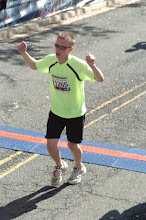
Hill training and it's benefits
Hill training promotes the development of lower leg and quad strength; a good hill training session combines the benefits of weight training with the aerobic and anaerobic conditioning of running. In addition, hill training strengthens you mentally; completing these tough workouts will help you deal with the physical discomfort of racing.
HOW OFTEN SHOULD I HILL TRAIN?
As a general rule, hill training is done once per week - done properly, these sessions are very demanding.
HOW LONG AND STEEP DOES THE HILL NEED TO BE?
Obviously the geography of where you live and train will dictate the type of hill you can train on; you've got to work with what you've got. The ideal hill for a strength and stamina hill workout should take you about 90 seconds to climb. The grade should be steep enough that you "feel the burn" in your legs over the last half or quarter of the hill repeat, yet not so steep that your normal running form is significantly compromised.
WHAT ABOUT INCORPORATING HILLS INTO MY EVERYDAY RUNS?
There is nothing wrong with running up and down hills as part of your everyday runs. However, like almost anything else, you can overdo it. You should avoid hilly terrain on your recovery runs. Also, more than three days in a row on a hilly course is more than most runners can handle.
WHAT MODIFICATIONS TO MY RUNNING FORM DO I NEED TO MAKE?
Climbing hills requires a slightly modified running technique. This involves shortening your normal stride, dropping your shoulders to ensure a lower arm carriage, and leaning slightly forward into the hill. You should aim for a strong, steady and consistent pace throughout the hill rep.
Running downhill also requires some modifications. Again, shortening the stride and leaning slightly forward is helpful. For steep down hills, thinking about leaping from one foot to the other can be an effective way to quickly negotiate the hill.
Showing posts with label Running Articles. Show all posts
Showing posts with label Running Articles. Show all posts
Wednesday, March 10, 2010
PACERS Running Tips - Hills
Let me make a confession, through all my training for 2 marathons I have never done a "hill workout" or a "track workout" not once, not never. I've had the INTENTIONS to do one or the other but I have never committed a workout purely to hills, that I can think of. Don't get me wrong, I run routes sometimes and will pick it purely because it is hilly in nature, such as my new favorite, Lake Barcroft loop. Regardless, today Pacers newsletter had a side article about training on hills and figured it was a great article to pass on. If you have not already, I strongly recommend going to the Pacers web-site and signing up for the newsletter here

Friday, March 5, 2010
SWPL - Marathons
For Christmas my sister-in-law and her fiance gave me a calendar entitled 'Stuff White People Like.' Now typically I am not that person that REALLY likes the message a day type calendars, as usually by January 15th or so I've completely lost interest in it, but this calendar is different. It's legitimately funny and I can usually find someone to relate each days item to, today it defined me as the item of the day was Marathons. I have posted the full piece from their web-site, hopefully you can relate too. I have emphasized the parts most relevant to me.
MarathonsHappy Friday!
In life, there are certain milestones of physical activity that can define you. A sub 5 second 40 yard dash, a 40 inch vertical leap and so forth. To a white person, the absolute pinnacle of fitness is to run a marathon. Not to win, just to run.
White people will train for months, telling everyone who will listen about how they get up early in the morning, they run when it rains, how it makes them feels so great and gives them energy.
When they finish the marathon, they will generally take a photo of themselves in a pair of New Balance sneakers, running shorts, and their marathon number with both hands over their head in triumph (seriously, look it up, this is universal).
They will then set goals like running in the Boston Marathon or the New York Marathon.
If you find yourself in a situation where a white person is talking about a marathon, you must be impressed or you will lose favor with them immediately. Running for a certain length of time on a specific day is a very important thing to a white person and should not be demeaned.
Also worth nothing, more competitive white people prefer triathlons because Kenyans can’t afford $10,000 specialty bicycles. If the subject ever comes up, just say that triathletes are in better shape than football and basketball players. It’s not true, but it will make the conversation a lot more genial.
Sunday, April 19, 2009
The legal stimulant....CAFFEINE
Lately I have been on a quest to reduce caffeine from my diet as much as possible in an attempt to use it to my advantage on race days. I just had coffee this morning (my 2nd cup in 3 days) so I figured I should remind myself of why I am trying to get rid of it. Just remember the no. 1 rule, "nothing new on race day"
So after reading this article again I guess I will revise my strategy just a little bit, I won't be cutting caffeine out completely but I am going to probably go out and get some caffeine pills and experiment with them prior to running. I already stick completely to the GU's with caffeine...my favorite is actually Vanilla, the kind almost everyone else hates! So here's my new equation!
 +
+ = New PR's
Personal Best
WELDON JOHNSON first tried caffeine as a performance enhancer in 1998. He was not a coffee drinker but had heard that caffeine could make him run faster. So he went to a convenience store before a race and drank a cup of coffee.
For the first time in his life, he ran 10 kilometers in less than 30 minutes.
“I remember being really wired before the race,” he said in an e-mail message. “My body was shaking.”
From then on, he was a convert.
Mr. Johnson, a founder of LetsRun.com, would avoid caffeine, even in soft drinks, for a few weeks before he competed in a race, wanting to have the full stimulant effect.
“It may have been a huge placebo effect, but I swore by it,” Mr. Johnson said. “Having a cup of coffee exactly one hour before the race was part of my routine.”
Or maybe it was not a placebo effect.
Caffeine, it turns out, actually works. And it is legal, one of the few performance enhancers that is not banned by the World Anti-Doping Agency.
So even as sports stars from baseball players to cyclists to sprinters are pilloried for using performance enhancing drugs, one of the best studied performance enhancers is fine for them or anyone else to use. And it is right there in a cup of coffee or a can of soda.
Exercise physiologists have studied caffeine’s effects in nearly every iteration: Does it help sprinters? Marathon runners? Cyclists? Rowers? Swimmers? Athletes whose sports involve stopping and starting like tennis players? The answers are yes and yes and yes and yes.
Starting as long ago as 1978, researchers have been publishing caffeine studies. And in study after study, they concluded that caffeine actually does improve performance. In fact, some experts, like Dr. Mark Tarnopolsky of McMaster University in Canada, are just incredulous that anyone could even ask if caffeine has a performance effect.
“There is so much data on this that it’s unbelievable,” he said. “It’s just unequivocal that caffeine improves performance. It’s been shown in well-respected labs in multiple places around the world.”
The only new questions were how it exerts its effects and how little caffeine is needed to get an effect.
For many years, researchers thought the sole reason people could exercise harder and longer after using caffeine was that the compound helped muscles use fat as a fuel, sparing the glycogen stored in muscles and increasing endurance. But there were several hints that something else was going on. For example, caffeine improved performance even in short intense bursts of exercise when endurance is not an issue.
Now, Dr. Tarnopolsky and others report that caffeine increases the power output of muscles by releasing calcium that is stored in muscle. The effect can enable athletes to keep going longer or to go faster in the same length of time. Caffeine also affects the brain’s sensation of exhaustion, that feeling that it’s time to stop, you can’t go on any more. That may be one way it improves endurance, Dr. Tarnopolsky said.
The performance improvement in controlled laboratory settings can be 20 to 25 percent, Dr. Tarnopolsky said. But in the real world, including all comers, the improvement may average about 5 percent, still significant if you want to get your best time or even win a race.
For years, researchers believed that you needed about 5 to 6 milligrams of caffeine per kilogram of body weight. An 80-kilogram, or 176-pound man, for example, would need about 400 milligrams of caffeine, or 20 ounces of coffee.
Now, Louise M. Burke, the head of sports nutrition department of the Australian Institute of Sport in Canberra, reports that athletes get the full caffeine effect with as little as 1 milligram of caffeine per kilogram of body weight. Instead of 20 ounces of coffee, a 176-pound man could drink 4 ounces of coffee, or about two 12-ounce cans of Coke.
It’s also possible to get diminishing returns.
Terry Graham, chairman of the Department of Human Health and Nutritional Sciences of the University of Guelph in Canada, found that at 9 milligrams per kilogram, athletes actually did worse.
Many athletes and coaches are not caffeine fans. Mr. Johnson said he has tried to spread the word and gets frustrated when runners don’t use caffeine — so much so, he said, that when he sees the team his brother coaches at Cornell, he thinks, why aren’t they all going to Starbucks?
Mike Perry, a friend who is a sculler who has competed nationally and internationally, said that, with one exception, the rowers he knew did not use caffeine.
“People would have psychological issues with using it,” he said. “They would see it as against the spirit of the law, even though it’s not against the law.”
Still, Mr. Perry wondered whether caffeine would help him. When he retired from rowing last July, he decided to do a randomized, blinded, placebo-controlled experiment on himself.
He noticed that the 200-milligram caffeine pills look exactly like Vitamin Cpills, allowing him to code the pills so that he would not know which one he had taken. For eight months he tested himself once a week, taking two pills an hour before working out on a rowing machine. Then he worked as hard as he could for an hour, recording the results, also recording his guess about whether the pills he took contained caffeine. Mr. Perry, who also is a runner, said that an hour on the rowing machine is the equivalent of an hour of very fast running on the road.
When he finished his study and broke the code late last month, he was astonished to see how much the caffeine had affected him. He was stronger — his power output was 3 percent greater — and faster. In fact, he said the average speed for his tests when he used caffeine was faster than his fastest speed when he was not using caffeine.
He also guessed right most of the time about whether the pills he took were caffeine or vitamin C. Mr. Perry said he is now sorry that he never used caffeine when he was competing. “It would have been a pretty harmless way to do better,” he said.
Others, including my son Stefan, disagree. I urged Stefan to try caffeine and he did. Once.
He took a caffeine pill before a track workout that involved running a mile very quickly, resting briefly, and running a mile again, repeatedly. Like Mr. Johnson, he was wired and shaking. But, Stefan said, he could not recover between miles. His heart was pounding and just would not slow down. He said he has no desire to experience that again.
Then there is the problem my running partner Jen Davis and I have. We love coffee and probably have caffeine in our blood all the time except during the middle of the night (it lasts for hours).
SO would we do better if we weaned ourselves from caffeine and then took a pill or two before a race?
I asked Dr. Tarnopolsky. It turns out, he said, that you get habituated to two of caffeine’s effects right away. Caffeine can make you urinate, but only if you are not used to it.
“Athletes do not get dehydrated from caffeine,” he added, “contrary to popular myth.”
And caffeine does increase the heart rate and blod pressure in people who are not regular uses. “But after three or four days, that potentially negative effect is gone,” Dr. Tarnopolsky said.
The beneficial effects on exercise, though, remain. Even if you are a regular coffee drinker, if you have a cup of coffee before a workout or a race, you will do better, Dr. Tarnopolsky said. “There is no question about it,” he added.
He puts the caffeine research to use when he trains and competes. Dr. Tarnopolsky is an elite triathlete, ski orienteer and trail runner who has competed at national and international levels. And, he said, he loves coffee: “I love the smell. I love the taste. It’s heaven.”
And before a race? He always has a cup.
So after reading this article again I guess I will revise my strategy just a little bit, I won't be cutting caffeine out completely but I am going to probably go out and get some caffeine pills and experiment with them prior to running. I already stick completely to the GU's with caffeine...my favorite is actually Vanilla, the kind almost everyone else hates! So here's my new equation!
+= New PR'sTuesday, April 7, 2009
Finishing your race strong
This morning after my run, I got my weekly Runners World e-mail and they had an article about finishing a race strong, and some training to do so that your still strong at the end.
Fatigue Intervals Instead of your normal 15-minute warmup before your long intervals, run 50 to 60 minutes. Your legs will likely feel tired, so don't worry if your interval splits fall off by a second or two per lap. Running fast while fatigued forces your body to recruit muscle fibers that might otherwise go untrained. Do this workout every third or fourth interval session.
Fast-Finish Long Run In the last third of your run, drop the pace by 20 to 30 seconds per mile. Concentrate on holding good form, which will help you stay relaxed as you push the pace. Make every second or third long run a fast-finish workout.
Mile Breakdown Do a two-mile warmup, then a mile at 5-K race pace, 1200 at one second per lap faster than the previous mile, 1000 at two seconds per lap faster than last mile, 800 at three seconds per lap faster, 600 at four seconds per lap faster, and 400 at five seconds per lap faster, with recovery equal to the time of the last interval. Incorporate this workout into your long interval rotation, and do it the Monday or Tuesday before a Sunday race to prime your speed for competition.
Step-Down Tempo Workout Start this 10-mile run at 1:20 per mile slower than your usual five-mile tempo pace. Every two miles drop the pace by 20 seconds per mile (your progression would look something like this: 8:05-8:05-7:45-7:45-7:25-7:25-7:05-7:05-6:45-6:45). While only the last two miles are at your normal tempo pace, the fact that you ran eight descending miles beforehand will make the pace feel more challenging. Replace your usual tempo run with this step-down approach about every third threshold workout.
http://www.runnersworld.com/article/0,7120,s6-238-244--12651-0,00.html?cm_mmc=training-_-2009_04_07-_-training-_-TRAINING%3a%20Finish%20Strong
Fatigue Intervals Instead of your normal 15-minute warmup before your long intervals, run 50 to 60 minutes. Your legs will likely feel tired, so don't worry if your interval splits fall off by a second or two per lap. Running fast while fatigued forces your body to recruit muscle fibers that might otherwise go untrained. Do this workout every third or fourth interval session.
Fast-Finish Long Run In the last third of your run, drop the pace by 20 to 30 seconds per mile. Concentrate on holding good form, which will help you stay relaxed as you push the pace. Make every second or third long run a fast-finish workout.
Mile Breakdown Do a two-mile warmup, then a mile at 5-K race pace, 1200 at one second per lap faster than the previous mile, 1000 at two seconds per lap faster than last mile, 800 at three seconds per lap faster, 600 at four seconds per lap faster, and 400 at five seconds per lap faster, with recovery equal to the time of the last interval. Incorporate this workout into your long interval rotation, and do it the Monday or Tuesday before a Sunday race to prime your speed for competition.
Step-Down Tempo Workout Start this 10-mile run at 1:20 per mile slower than your usual five-mile tempo pace. Every two miles drop the pace by 20 seconds per mile (your progression would look something like this: 8:05-8:05-7:45-7:45-7:25-7:25-7:05-7:05-6:45-6:45). While only the last two miles are at your normal tempo pace, the fact that you ran eight descending miles beforehand will make the pace feel more challenging. Replace your usual tempo run with this step-down approach about every third threshold workout.
http://www.runnersworld.com/article/0,7120,s6-238-244--12651-0,00.html?cm_mmc=training-_-2009_04_07-_-training-_-TRAINING%3a%20Finish%20Strong
Subscribe to:
Posts (Atom)